
A free download tells you what it costs to install a hidden-object game. It does not tell you what it costs to finish the adventure. Before comparing prices, write down the version you intend to play and the content you actually want.
Separate a one-time full-game unlock from purchases that can repeat. An optional soundtrack belongs in a different column from a hint pack that can run out. You can then decide whether you want a fixed price or are comfortable managing extra purchases during play.
Compare equivalent purchases
Scroll the table sideways on a narrow screen to see every column.
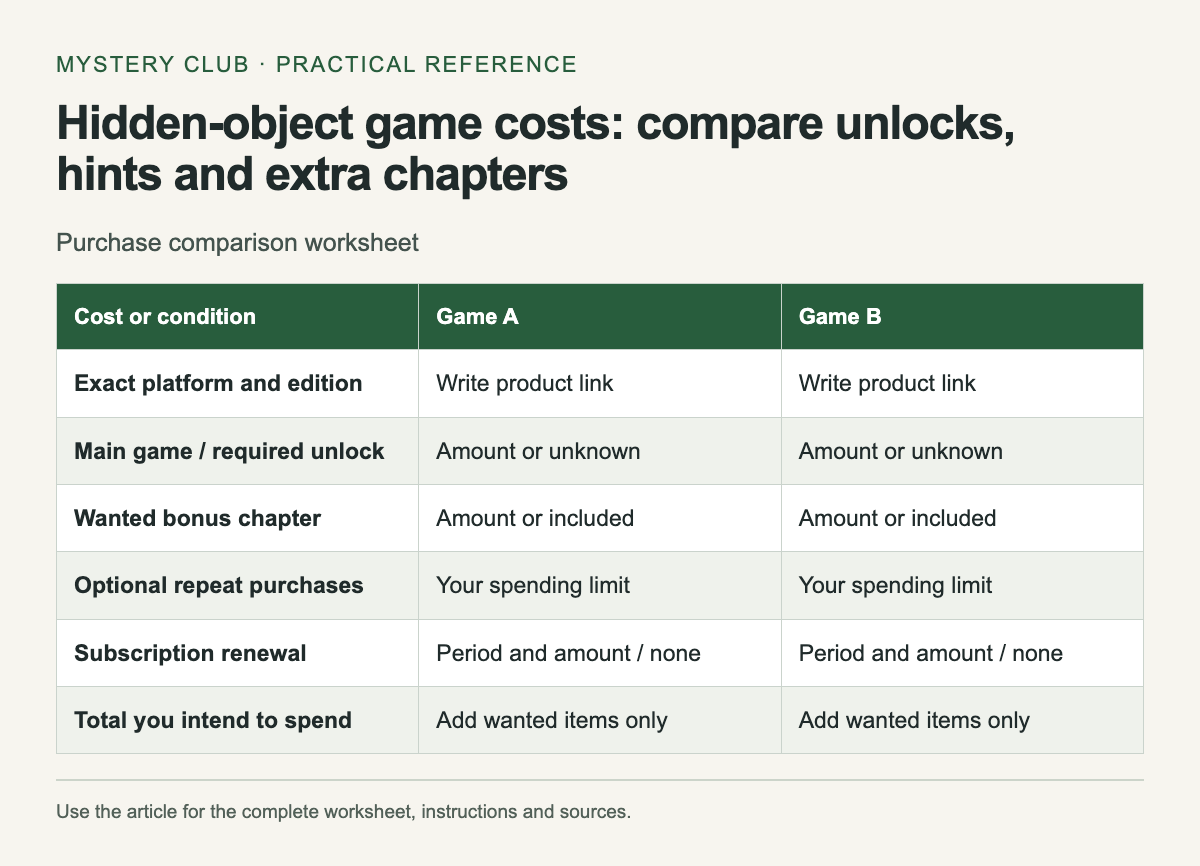
| Cost or condition | Game A | Game B |
|---|---|---|
| Exact platform and edition | Write product link | Write product link |
| Main game / required unlock | Amount or unknown | Amount or unknown |
| Wanted bonus chapter | Amount or included | Amount or included |
| Optional repeat purchases | Your spending limit | Your spending limit |
| Subscription renewal | Period and amount / none | Period and amount / none |
| Total you intend to spend | Add wanted items only | Add wanted items only |
Leave a cell unknown when the store does not explain it. Zero means you checked and the charge does not apply; it should not mean you failed to find the answer. Contact the publisher if a required chapter or recurring purchase remains unclear.
Read the purchase label carefully
The ESRB guide explains that the In-Game Purchases label can cover several kinds of paid digital content, including extra levels, subscriptions and upgrades. The label alone cannot tell you whether a game sells consumable hints or simply offers an expansion.
Open the store's purchase details for your platform. A PC package and a similarly named mobile app may use different payment systems. Match the developer, edition and product page before carrying a recommendation from one store to another.
Decide what counts as the full experience for you
If you want only the main story, record its required cost. If the bonus chapter matters, add it. Keep cosmetic extras and music separate unless you genuinely intend to buy them. A larger bundle is not automatically better value when its extra items will remain unused.
Check whether a collector's edition includes the standard game or is an upgrade requiring it. Read the bundle contents even when the cover art looks familiar. Write down the included chapter names or listed extras rather than relying on a vague "complete" label.
Budget for repeat purchases explicitly
If a game sells consumables, choose a maximum additional spend before starting. A hypothetical example: a 12-unit unlock plus two optional 3-unit hint packs would cost 18 units. That is arithmetic, not a price quote or a prediction that you will need those hints.
You can also set the consumables allowance to zero and see whether the game remains appealing. Read how hints are earned or replenished. Avoid treating a lack of purchases during an introductory section as proof that later chapters use the same rules.
Check account and device assumptions
Find the publisher's explanation of purchase restoration if you expect to reinstall or move devices. Keep the receipt in the store account you used. Do not assume that buying an Android app unlocks its desktop edition, or that a family member can use your purchase through a separate account.
Subscriptions need an extra line for renewal period and cancellation. A monthly price only becomes comparable with a one-time purchase after you choose how many months you expect to use it. Mark that duration as your estimate, and recalculate if your plan changes.
Before paying, read the final checkout total in your own currency. Discounts and regional prices change, so the worksheet should contain today's amount and the exact product link. Recheck an old note before using it to recommend the same purchase to someone else.
For the edition comparison, use the Collector’s Edition buying guide.
Comments