
Overboard! rewards a useful second attempt. After a messy first voyage, keep a short record of who saw you, where they were and which conversation changed the situation. This spoiler-free beginner guide turns that record into a replay plan without giving away a winning route or another passenger's secrets.
In inkle's fictional murder mystery, you play the culprit. The ship will arrive in eight hours of story time, and the other characters have their own movements and memories. They can remember what they see and hear, so an action's witnesses matter alongside the action itself. These are core features described in inkle's official game overview.
My recommendation is to give the second voyage one question: what changes if you reach the same conversation earlier? Keep the rest of the route as close as possible to your first attempt. Changing every decision may reveal something new, but it makes a particular setback harder to explain.
Give the first voyage one manageable goal
Use your first attempt to understand the ship and follow one promising conversation. Trying to account for every person, object and possible accusation at once makes it difficult to remember what caused a setback. If you learn where one passenger goes and what makes them suspicious, you have something concrete to test next time.
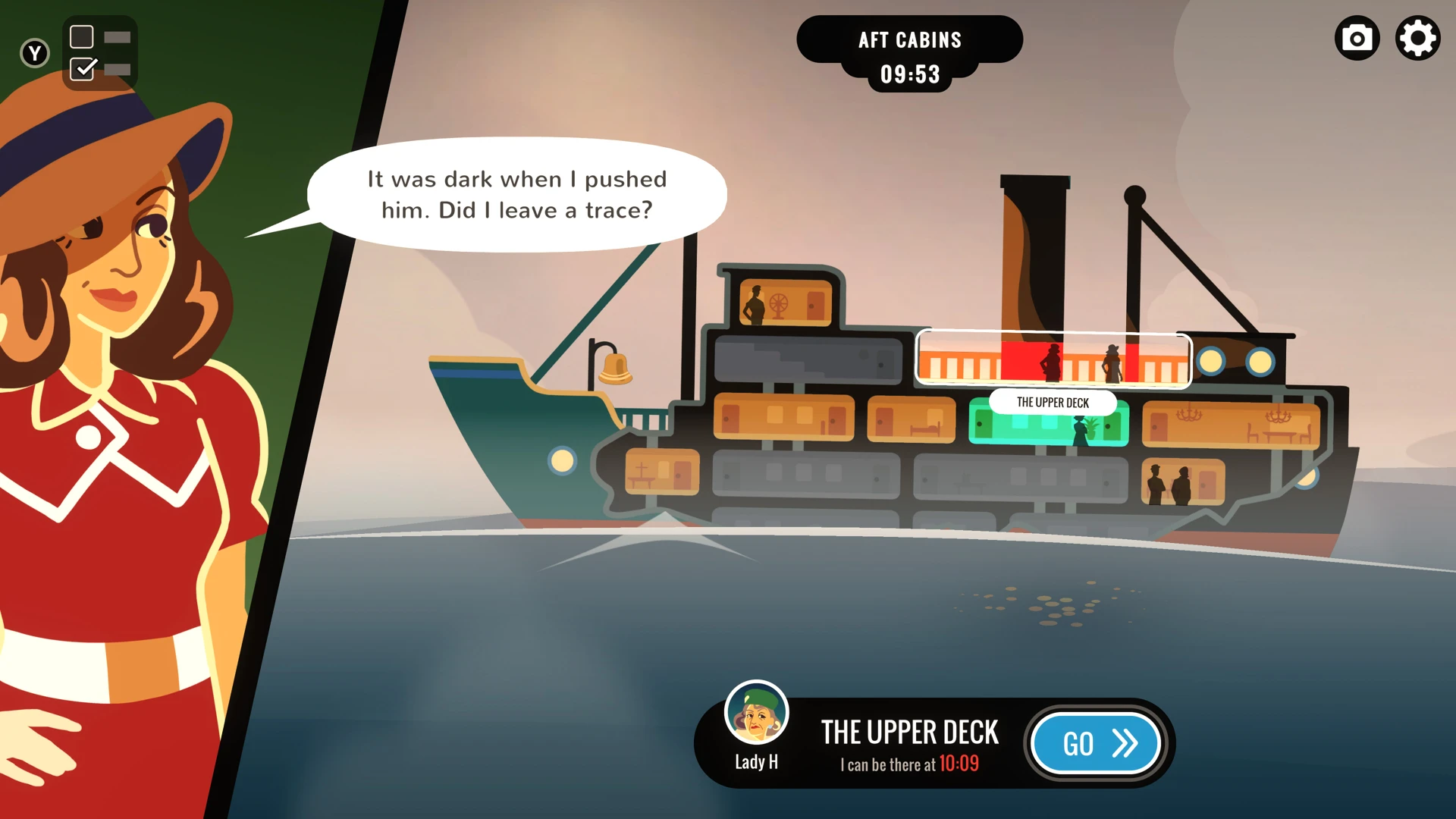
Read the available choices before committing. When the game presents a destination and arrival time, compare that with the clock. The official map screenshot above shows both: a current time and a later arrival time for the selected destination. A nearby conversation can still carry a time cost; don't assume you can visit every interesting room before the ship arrives.
Keep observations separate from guesses
Write an observation as a small event: person, place, approximate time, what you did and the response. Then put your explanation in a separate column. “They accused me after our conversation” is an observation. “That particular answer caused the accusation” is a hypothesis until you test it.
Use the following table on paper or in a notes app. The entries are prompts, not a walkthrough. Leave unknown details blank rather than filling them from memory. If a scene moves quickly, capture only the unexpected result and return to the details after the voyage.
| Record | What to write | How it helps the replay |
|---|---|---|
| Starting point | Room and displayed time before your choice | Check whether you reached the same situation. |
| People present | Who you actually saw nearby | Distinguish a private action from an observed one. |
| Action or answer | A brief description of your selected choice | Identify the decision you intend to change. |
| Observed result | New information, reaction or changed access | Keep the evidence separate from your interpretation. |
| Next experiment | One alternative choice or earlier visit | Give the next voyage a specific question. |
Change one part of the route
- Pick the setback you understand least. Choose one conversation, missed meeting or witnessed action.
- Replay the earlier sequence as closely as you can, noting any difference in time or who is present.
- Try one different answer, destination or order of visits.
- Record the new result before inventing an explanation for it.
If you changed both the timing and the dialogue, you cannot yet tell which difference mattered. That does not make the attempt wasted: mark both changes and narrow the question on another run. Inkle specifically describes replaying as a way to use knowledge from an earlier voyage, in its official Overboard! press kit.
Decide what to investigate next
After each attempt, choose between learning a new part of the ship and improving a route you already understand. Exploration is useful when your notes contain mostly unknowns. A controlled replay is more useful when you have a clear theory about a single encounter. Avoid treating every unsuccessful ending as a reason to restart your entire approach.
Keep notes about different voyages on separate lines. Information you learned as a player is not proof that a particular character witnessed the same thing in the current run. Before relying on an accusation or an alibi, review what actually happened on this voyage.
For a broader note-taking format, see our Chants of Sennaar notebook guide, which also separates evidence from interpretation. If you decide to look up help, the spoiler-light hint checklist explains how to request a narrow nudge. For Overboard!, ask about one encounter and state the time and actions you have already tried; a full ending guide reveals much more than that question requires.
Official Overboard! press screenshot showing travel planning aboard the ship. Image: inkle.
Comments