

In a fragmented hidden-object scene, you look for parts of an object that will be assembled, instead of simply checking whole objects off a written list. The useful question is how the game shows those missing parts. A clear outline can make a scene approachable; a tiny fragment preview can make the same task demanding.
Start by studying the target panel before searching the picture. Identify the shape of one missing piece and the object it belongs to. If you try to hold every fragment in mind at once, similar curves and corners can become hard to distinguish.
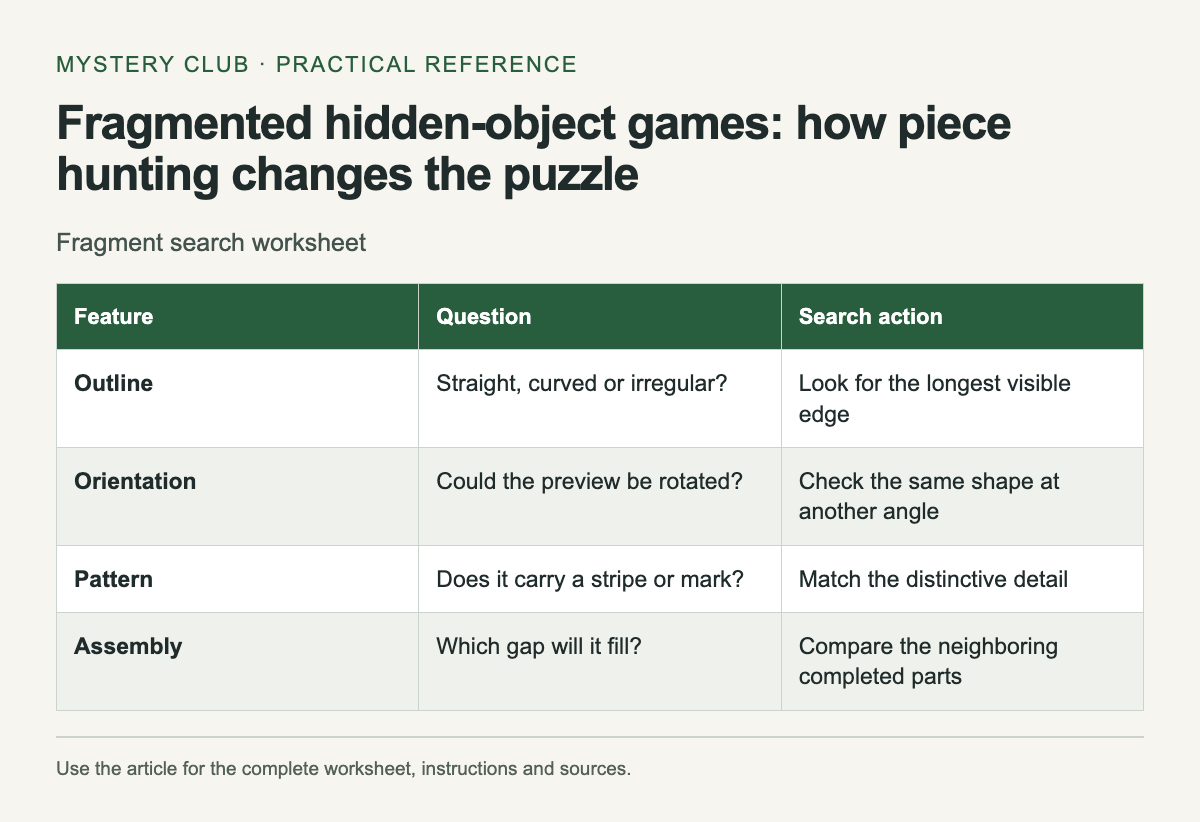
Use the missing shape as a clue
Scroll the table sideways on a narrow screen to see every column.
| Feature | Question | Search action |
|---|---|---|
| Outline | Straight, curved or irregular? | Look for the longest visible edge |
| Orientation | Could the preview be rotated? | Check the same shape at another angle |
| Pattern | Does it carry a stripe or mark? | Match the distinctive detail |
| Assembly | Which gap will it fill? | Compare the neighboring completed parts |
These are search strategies, not guaranteed placement rules. A fragment can be rotated or partly hidden, and an artwork style may make material harder to judge. Use several visible features together before deciding that a shape is the one you need.
Read the assembled object
The overall object can suggest what a missing part might look like. A gap in a wheel suggests a curved edge, while a gap in a handle suggests a narrower piece. Treat that as a hypothesis, then compare the fragment preview or silhouette if the interface provides one.
Avoid assuming that every piece resembles the material of the finished object. A small part may be mostly shadow or decoration. Search the shape first when color keeps sending you toward unrelated scenery.
Work on one target at a time
Choose an object with a distinctive missing piece and make one deliberate sweep. If you do not find it, switch to an object whose fragment has a different outline. That changes what you are looking for without turning the session into random clicking.
After a piece is found, inspect the target panel again. The newly assembled section may make another missing part easier to recognize. Record only the few pieces that remain confusing; a full written inventory usually adds work without helping the search.
Inspect the interface before buying
Look at a screenshot at roughly the size you expect to play. Can you distinguish the fragment previews? Does a selected object become larger? If a demo is available, check those controls directly. A close-up promotional image does not establish that the normal interface is readable on a small laptop.
Find out whether hints identify a piece, an entire scene, or another action. The label "hint" does not describe its exact behavior. If you want to solve most scenes yourself, a gentle pointer may suit you better than an immediate reveal, but the preference is personal.
Keep genre labels in perspective
Some adventures combine fragmented searches with ordinary lists and inventory puzzles. One screenshot is enough to show that a mechanic appears, but not how often it appears. Read the publisher's description and inspect a second gameplay segment before treating the whole game as a pure example of one format.
The existing Dark Parables guide gives you titles to investigate. Check the particular entry's scenes and edition instead of assuming every game in a series uses identical rules.
If ordinary object lists have started to feel repetitive, a fragmented scene changes the visual task without requiring you to commit to a whole new genre. Try a normal scene first and pay attention to whether recognizing pieces is satisfying on your screen. That experience is a better buying signal than the abbreviation attached to the store page.
For stories around the searches, browse the Fantasy adventures with hidden objects.
Comments