
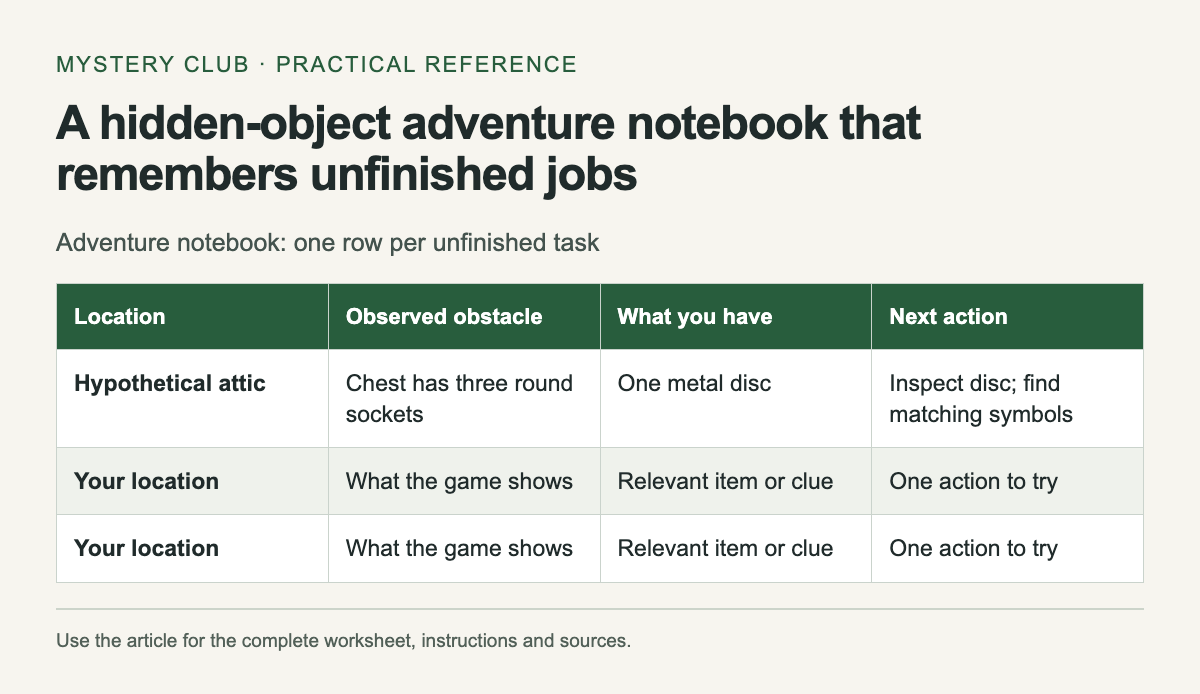
The hardest part of returning to a hidden-object adventure after a week away can be remembering which door needed which object. A notebook helps when it records unfinished jobs. A page full of plot summary usually leaves you with the same locked door and no idea what to try.
Use one row per obstacle. Put the location first so you can find the note while moving around the map. Keep the wording short enough to scan during play: "attic chest, three round sockets, found one disc" is more useful than a paragraph about arriving upstairs.
Copy this worksheet
Scroll the table sideways on a narrow screen to see every column.
| Location | Observed obstacle | What you have | Next action |
|---|---|---|---|
| Hypothetical attic | Chest has three round sockets | One metal disc | Inspect disc; find matching symbols |
| Your location | What the game shows | Relevant item or clue | One action to try |
| Your location | What the game shows | Relevant item or clue | One action to try |
The sample row is a hypothetical puzzle, not a solution from a game. Replace it with a real observation from your current session. If you prefer paper, print the table and leave space between rows for changes; if you prefer a notes app, keep the same column order.
Record what the game shows
Separate visible evidence from your interpretation. "Three sockets" is evidence. "Needs three coins" is a guess until you have an item or clue that supports it. Put guesses in the next-action column so they do not gradually become facts in your memory.
You can use a question mark for uncertain details. Avoid filling a notebook with elaborate theories about every decorative object. Record an object when the game lets you inspect it, names it, or gives you a reason to return. This keeps the page useful instead of turning it into a second inventory to manage.
Give clues a location
A number sequence without its source becomes surprisingly hard to use later. Note where you found the sequence and what appeared beside it. A drawing of a sun, a color order or the orientation of a symbol can matter as much as the digits.
If a screenshot is easier, name it with the location and clue type. You do not need to transcribe every detail twice. Keep the notebook entry as an index to the image, then check the original image before entering a code.
Close completed jobs
When an obstacle is resolved, mark the row complete instead of deleting it immediately. The record can explain why you no longer have a particular item. At the end of a chapter, archive completed rows and leave only the tasks that remain available.
Write one return note before quitting: current location, active objective and next action. That note should take less than a minute. If the game has an automatic journal, use your own page for information it omits rather than duplicating its text.
Match the notebook to the game
A linear game may need only two or three live rows. An adventure with many open locations benefits from a separate section for each area. Follow the actual map labels where possible; your private nickname for a room can be difficult to match with an in-game hint.
For a story-heavy series, keep factual puzzle notes away from plot theories. Characters belong to the game's fictional story, and your guesses about their motives may change. You should be able to find the missing handle without scrolling through every suspicion you had about the cast.
If you share the notebook, ask the other player whether they want solved entries visible. A completed row can be a spoiler even when it contains no story detail. Copy just the open tasks when helping someone who is behind you.
A longer inventory adventure to consider is Lost Lands: Dark Overlord.
Comments